What Salary or Less Was the Government's Definition of Poverty for a Family of Four in 2011?
2.1 The Measurement and Extent of Poverty
Learning Objectives
- Sympathize how official poverty in the United States is measured.
- Describe problems in the measurement of official poverty.
- Describe the extent of official poverty.
When US officials became concerned about poverty during the 1960s, they rapidly realized they needed to notice out how much poverty we had. To practice so, a measure of official poverty, or a poverty lineThe regime's measure of official poverty, based on the cost of a minimal diet for a family that is then multiplied past iii. , was needed. A government economist, Mollie Orshanky, first calculated this line in 1963 by multiplying the toll of a very minimal diet by iii, as a 1955 government study had adamant that the typical American family unit spent one-third of its income on food. Thus a family whose cash income is lower than three times the price of a very minimal diet is considered officially poor.
This way of calculating the official poverty line has not changed since 1963. Information technology is thus out of date for many reasons. For example, many expenses, such as heat and electricity, child care, transportation, and wellness care, now occupy a greater percentage of the typical family'south budget than was true in 1963. In addition, this official measure out ignores a family'southward noncash income from benefits such as food stamps and tax credits. As a national measure, the poverty line also fails to take into account regional differences in the cost of living. All these bug make the official measurement of poverty highly suspect. Equally one poverty expert observes, "The official mensurate no longer corresponds to reality. It doesn't become either side of the equation right—how much the poor take or how much they need. No i really trusts the data" (DeParle, Gebeloff, & Tavernise, 2011, p. A1).DeParle, J., Gebeloff, R., & Tavernise, S. (2011, November 4). Bleak portrait of poverty is off the mark, experts say. New York Times, p. A1. We'll return to this outcome presently.
The poverty line is adjusted annually for aggrandizement and takes into account the number of people in a family unit: The larger the family size, the higher the poverty line. In 2010, the poverty line for a nonfarm family of four (two adults, two children) was $22,213. A 4-person family earning fifty-fifty one more dollar than $22,213 in 2010 was not officially poor, even though its "actress" income hardly lifted information technology out of dire economic straits. Poverty experts accept calculated a no-frills budget that enables a family to meet its bones needs in food, clothing, shelter, and and then forth; this budget is well-nigh twice the poverty line. Families with incomes betwixt the poverty line and twice the poverty line (or twice poverty) are barely making ends meet, merely they are not considered officially poor. When we talk here about the poverty level, then, go along in mind that we are talking only about official poverty and that there are many families and individuals living in nigh poverty who have problem meeting their basic needs, especially when they confront unusually high medical expenses, motor vehicle expenses, or the like. For this reason, many analysts recall families need incomes twice as high equally the federal poverty level only to get by (Wright, Chau, & Aratani, 2011).Wright, V. R., Chau, M., & Aratani, Y. (2011). Who are America'due south poor children? The official story. New York, NY: National Eye for Children in Poverty. They thus use twice-poverty data (i.e., family unit incomes beneath twice the poverty line) to provide a more authentic understanding of how many Americans face serious financial difficulties, fifty-fifty if they are not living in official poverty.
The Extent of Poverty
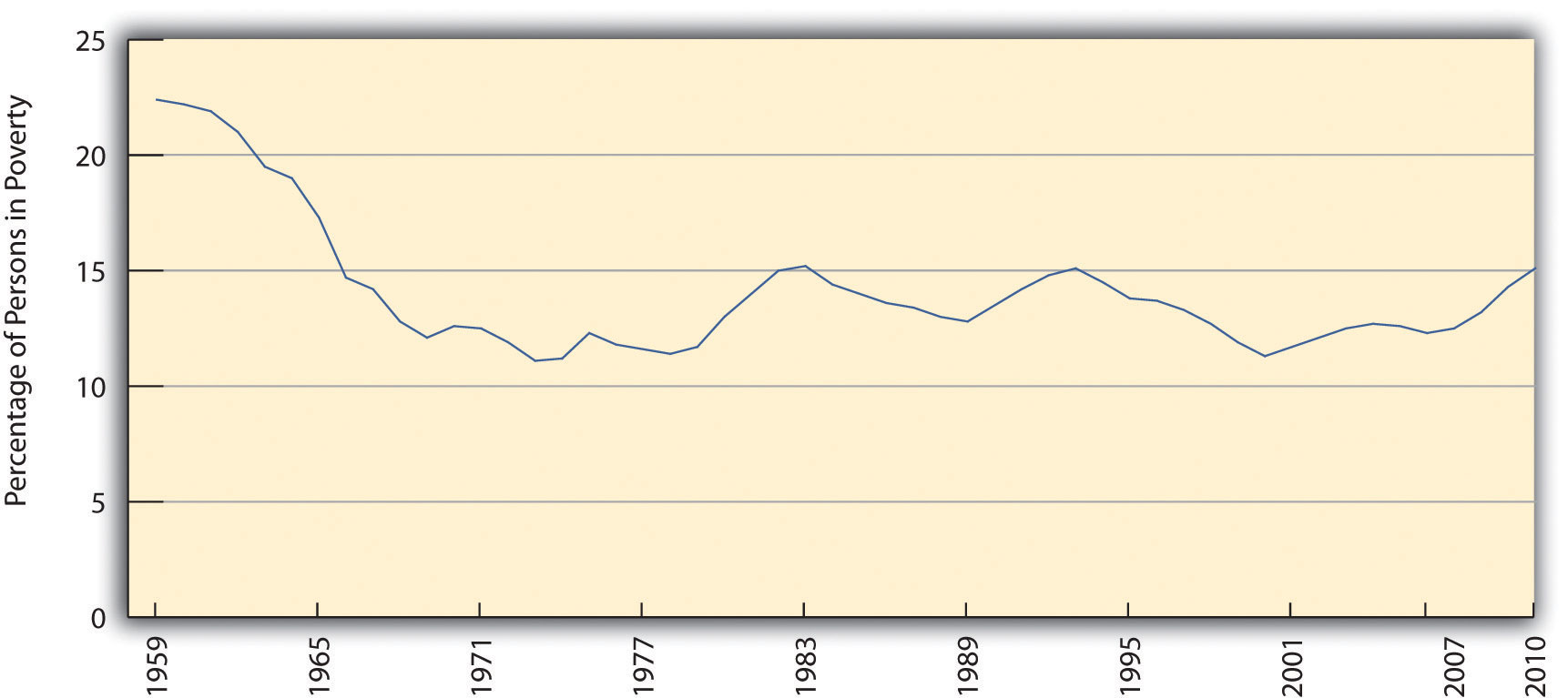
With this caveat in heed, how many Americans are poor? The U.s. Census Agency gives united states some answers that use the traditional, official measure of poverty adult in 1963. In 2010, fifteen.1 percent of the US population, or 46.2 one thousand thousand Americans, lived in official poverty (DeNavas-Walt, Proctor, & Smith, 2011).DeNavas-Walt, C., Proctor, B. D., & Smith, J. C. (2011). Income, poverty, and health insurance coverage in the United States: 2010 (Electric current Population Reports, P60-239). Washington, DC: United states Demography Agency. This percentage represented a turn down from the early on 1990s but was higher than 2000 and even higher than the rate in the belatedly 1960s (see Figure 2.1 "United states Poverty, 1959–2010"). If we were winning the war on poverty in the 1960s (notice the sharp drop in the 1960s in Figure 2.1 "US Poverty, 1959–2010"), since then poverty has fought usa to a standstill.
Figure 2.1 Us Poverty, 1959–2010
Some other way of understanding the extent of poverty is to consider episodic povertyAs defined by the Census Agency, being poor for at least two consecutive months in some time period. , divers by the Demography Agency as beingness poor for at to the lowest degree two consecutive months in some time catamenia. From 2004 to 2007, the last years for which data are available, near one-third of the US public, equal to about 95 million people, were poor for at least 2 sequent months, although only two.2 percent were poor for all three years (DeNavas-Walt, et al., 2010).DeNavas-Walt, C., Proctor, B. D., & Smith, J. C. (2010). Income, poverty, and health insurance coverage in the Usa: 2009 (Current Population Reports, P60-238). Washington, DC: US Census Bureau. As these figures indicate, people get into and out of poverty, but even those who go out of it do not usually movement very far from it. And equally we accept seen, the bulk of Americans can expect to experience poverty or about poverty at some point in their lives.
The issues in the official poverty measure that were noted before accept led the Census Bureau to develop a Supplemental Poverty Measure out. This measure takes into account the many family unit expenses in improver to nutrient; it also takes into account geographic differences in the cost of living, taxes paid and tax credits received, and the provision of food stamps, Medicaid, and certain other kinds of regime aid. This new measure yields an estimate of poverty that is college than the rather simplistic official poverty measure out that, equally noted before, is based solely on the size of a family unit and the cost of food and the amount of a family'south cash income. According to this new measure, the 2010 poverty charge per unit was xvi.0 percent, equal to 49.1 million Americans (Brusque, 2011).Curt, K. (2011). The inquiry supplemental poverty measure: 2010 (Current Population Reports, P60-241). Washington, DC: U.s.a. Census Bureau. Because the official poverty measure identified 46.2 million people as poor, the new, more than accurate measure increased the number of poor people in the Usa by virtually three million. Without the help of Social Security, food stamps, and other federal programs, at least 25 million additional people would be classified as poor (Sherman, 2011).Sherman, A. (2011). Despite deep recession and high unemployment, authorities efforts—including the Recovery Human action—prevented poverty from ascent in 2009, new census information show. Washington, DC: Center on Upkeep and Policy Priorities. These programs thus are essential in keeping many people above the poverty level, even if they however have trouble making ends meet and even though the poverty rate remains unacceptably high.
A final figure is worth noting. Recall that many poverty experts remember that twice-poverty information—the percentage and number of people living in families with incomes below twice the official poverty level—are a amend gauge than the official poverty level of the bodily extent of poverty, broadly defined, in the United States. Using the twice-poverty threshold, almost one-third of the Usa population, or more 100 million Americans, live in poverty or nigh poverty (Pereyra, 2011).Pereyra, L. (2011). Half in Ten entrada criticizes Firm Republican funding proposal. Washington, DC: Eye for American Progress. Those in nigh poverty are just ane crunch—losing a job or sustaining a serious illness or injury—away from poverty. Twice-poverty data paint a very discouraging picture.
Key Takeaways
- The official poverty rate is based on the size of a family and a minimal food budget; this measure underestimates the true extent of poverty.
- The official poverty rate in 2010 was 15.1 percentage, equal to more than 46 million Americans.
- Nearly one-tertiary of the US population, or more than 100 million Americans, have incomes no college than twice the poverty line.
For Your Review
- Write a short essay that summarizes the problems by which the official poverty rate is determined.
- Sit down downwards with some classmates and judge what a family of four (two parents, two young children) in your area would take to pay annually for food, wear, shelter, energy, and other necessities of life. What figure do you lot finish upwardly with? How does this sum of coin compare with the official poverty line of $22,213 in 2010 for a family of four?
fitzgeraldrappe1950.blogspot.com
Source: https://saylordotorg.github.io/text_social-problems-continuity-and-change/s05-01-the-measurement-and-extent-of-.html
0 Response to "What Salary or Less Was the Government's Definition of Poverty for a Family of Four in 2011?"
Post a Comment