Who Were the Original Members of the New York School of Art
Every possible thing changed with the beginning of World War 2 equally the world witnessed countries occupied past Nazi Germany one by one. Their credo based on the concept of blut and boden (claret and soil) on one hand, and social Darwinism on the other, was harsh and clear – whatever person who did not fit to the platonic image of an Arian was to be easily displaced or destroyed.
This was the case with numerous artists likewise, many of whom were Jews, queers, and communists (or all 3 in i). Some of them were publicly humiliated, their works destroyed, and their possessions confiscated. An array of them managed to exit their country on time, and move to the United States. In the new environment, they adapted chop-chop, got teaching posts, and therefore made a lasting influence on the upcoming generation of American artists.
The best example is a loose group that was active in New York during the early mail service-war period. Just chosen The New York School, information technology attracted non only visual artists, only also poets, musicians, and choreographers. Part of this miracle is the story of Abstruse Expressionism which ultimately became one of the most influential 20th-century movements.
The New York School – The New Avant-garde
The proponents of The New York School combined European Avant-garde aesthetics (they were mostly inspired by Surrealism) with the American desire for social relevancy. Heaven for artists during the tardily 1940s and early 1950s, New York quickly became a new capital of fine art after Paris.
Art and life were inseparable for the Europeans, meaning that every possible aspect of their daily activity was associated with their product. Through a dialog with the younger American artists, they tended to empower them not just to learn the craft, but too to articulate what it means to exist an artist.
The European café culture typical for the art globe was no longer possible in an overcrowded New York where the artists had to search for adequate housing. For that reason, information technology was hard to establish a firm connection of a specific neighborhood with a particular movement. However, Greenwich Village eventually became a focus for the New York School.
The painters of the New York School use to assemble often in certain confined, in automats and cafes, or in studios around Greenwich Village, along with the critics Clement Greenberg, Thomas Hess and Harold Rosenberg, and the fine art historian Meyer Schapiro.
The artists of the New York School expressed themselves differently, simply they managed to experiment in large with both course and content. The lead figures who stood at the forefront of the motility were Jackson Pollock, Willem de Kooning, and Marker Rothko, along with numerous others like Philip Guston, Karel Appel, Betty Parsons, and Antoni Tapies.
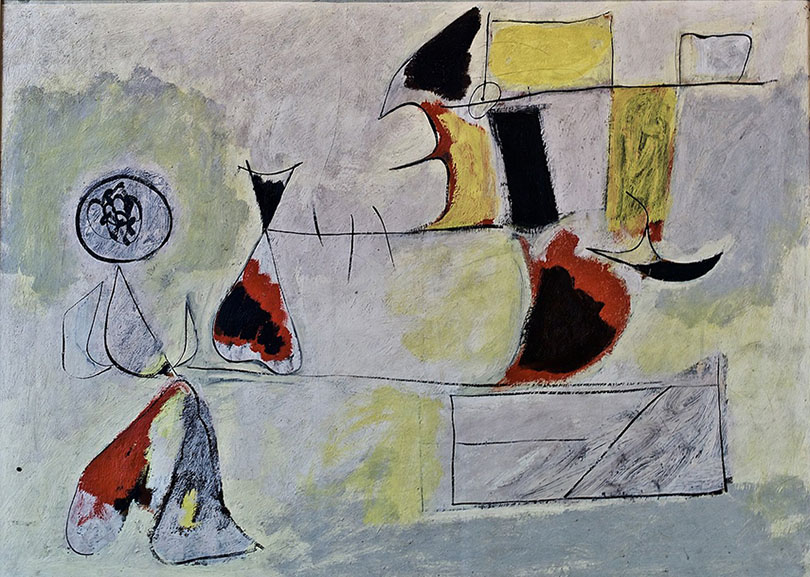
The Exhibitions and Other Disciplines
Among the most important exhibitions that featured the artists of the New York Schoolhouse throughout the 1950s were a series of artists' committee exhibitions starting with the 9th Street Fine art Exhibition in 1951. Before the mainstream breakthrough, the artists affiliated with the movement exhibited their works at Peggy Guggenheim's The Art of This Century, Pierre Matisse Gallery, Julien Levy Gallery, and the Anita Shapolsky Gallery. Some of them got wider attention thanks to their well-established patron critics (Greenberg championed Pollock, and the Color Field painters such as Hans Hoffman, Adolph Gottlieb, Mark Rothko, Barnett Newman, and Clyfford Still; while the piece of work of Franz Kline and William de Kooning was saluted by Harold Rosenberg).
The leading poet of the New York Schoolhouse was Frank O'Hara who also acted every bit a curator at the Museum of Modern Art; he established a firm liaison between the poets and painters. The works of the prominent composers of the 1950s similar John Muzzle and Morton Feldman (whose music had a profound influence on the Fluxus group) also belong to the movement, also as the later activeness of the Judson Trip the light fantastic Theater, the leading trip the light fantastic company that redefined modern dance by combining the avant-garde music, functioning fine art, and radical choreography.
The New York School Movie - Trailer
The Significance of The New York School'due south Abstruse Painting
By the 1950s, The New York Schoolhouse received wider international recognition, and numerous younger artists started embracing its artful. However, the representatives of the second generation focused more on the painterly technique adult by the Abstract Expressionists than existential motives that were explored past the initial group of artists. For that reason, information technology seems more likely that the legacy of The New York School was further pursued past the shell generation led by the likes of Allen Ginsberg and Jack Kerouac who managed to project the gestural rawness of the abstract painting onto everyday feel in the public space.
The 1960s brought a new wave of bold ideas, but some of the leading figures of the New York Schoolhouse such as William de Kooning, Robert Motherwell, Helen Frankenthaler, David Smith, and Philip Guston, created some of their best-known works during this decade.
This phenomenon changed the form of modern art thanks to the European artists who established a business firm sense of internationalism and presented new models of art-making. The Americans used this cognition wisely and created an extremely fruitful atmosphere that fabricated a lasting bear upon on the upcoming generations of artists.
For those and all the mentioned reasons in a higher place, The New York Schoolhouse is rightfully considered to be i of the most influential art movements after WW II.


With the emergence of Abstruse Expressionism after Earth State of war II, the attending of the international art earth turned from Paris to New York. Dore Ashton captures the vitality of the cultural milieu in which the New York Schoolhouse artists worked and argued and critiqued each other's work from the 1930s to the 1950s. Working from unsifted archives, from contemporary newspapers and books, and from extensive conversations with the men and women who participated in the rise of the New York School, Ashton provides a rich cultural and intellectual history of this period. In examining the complex sources of this of import move―from the WPA plan of the 1930s and the influx of European ideas to the recognition in the 1950s of American painting on an international calibration―she conveys the concerns of an extraordinary group of artists including Willem de Kooning, Jackson Pollock, Ad Reinhardt, Philip Guston, Barnett Newman, Arshile Gorky, and many others.
Featured image: Cover of The New York Schoolhouse Book by Maurice Tuchman. Image via amazon.com.
fitzgeraldrappe1950.blogspot.com
Source: https://www.widewalls.ch/magazine/the-new-york-school
0 Response to "Who Were the Original Members of the New York School of Art"
Post a Comment